
A Rehabilitation Program for Dementia?
Why None Exist Today
“It is far more important to know what person the disease has than what disease the person has.”
— Hippocrates
“Vital heat, which plays an essential role in sustaining life, decreases with age, leading to the degeneration of sense perception and intellectual ability.”
— Aristotle
“The rehab staff said Mum wasn’t motivated. I told them that was because she didn’t have her slippers. She wouldn’t walk in bare feet at home without her slippers so no way would she walk on a hospital floor without them! As soon as she got the slippers, she did all her exercises.” Mrs Smith has no rehab potential
Reimagining the Unthinkable: Dementia and Rehabilitation
Let me pose a simple but thought-provoking question: Why is there no standardized rehabilitation program for dementia?
In an age where people recover from strokes, manage chronic incurable conditions such as Parkinson’s, and even return to mobility after spinal injuries, why does the word “rehabilitation” vanish from the conversation the moment someone receives a dementia diagnosis?
I’m going to go out on a limb and suggest that I may be one of the first individuals with officially diagnosed, full-blown Frontotemporal Dementia (FTD) to design and pursue a custom-made, self-orchestrated rehabilitation program—and to attempt to document its progress from the inside.
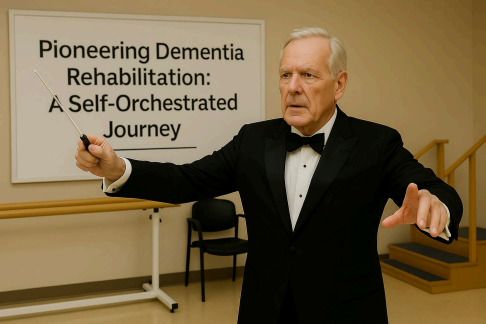 ChatGPT 4 generated image at author's request- Orchestrating one’s own dementia rehabilitation program is like conducting a large symphony without the conductor’s score.
If there are others that have done this, I haven’t found them. If medical journals or case studies exist chronicling a significant partial recovery from dementia, they remain well hidden from public view. So perhaps this is more than a personal story—perhaps it's the beginning of a new conversation.
The Chasm After Diagnosis
When I finally received a definitive diagnosis in 2021, I had consulted four different
specialists. Not one of them gave me a single actionable recommendation beyond vague platitudes. No targeted plan. No “next steps.” No hope. Just a couple of prescriptions, one for Aricept (for Alzheimer’s Cognitive Symptoms) and the other for ropinirole (for easing movement in Parkinson’s).
Not even any advice on how to manage the health factors that clearly accelerate cognitive decline—like my borderline diabetes and extra 45 pounds. These were treated as incidental, when in fact they were immediate fuel to the fire.
When I asked what I could do to improve my condition, the answer was chilling: “Nothing. This is a degenerative disease. There is no treatment” the last physician we consulted quipped while we were on our way out of her clinic in the suburbs of Seattle.
As I stumbled out of the office, grasping at straws, I muttered something about neuroplasticity and the brain’s incredible capacity to heal. The doctor shrugged: “It might be possible” were the last words I heard as we exited.
And that was it. My wife and I were left in the emotional wreckage of that fifteen-minute conversation with a seemingly final verdict—and no path forward, no hope at all.
The Elephant in the Room
Let me be clear: this is not about miracle cures or false hope. But it is about the glaring omission in how dementia is treated, or should I say, is not treated.
Rehabilitation is the bedrock of recovery in almost every other field of medicine. If you have a stroke, you get physical therapy, occupational therapy, speech therapy, and a personalized care plan. If you are diagnosed with Parkinson’s, you get Big Step therapy. If you survive a heart attack, you're guided through cardiac rehab. Even my in-law diagnosed with unspecified dementia was guided through physical therapy at a hospital to aid in getting up and walking again after surgery for a broken hip, but only for her postsurgical recovery, nothing beyond that. If you have dementia, the system essentially writes you off and forgets about you.
There are excellent individual therapies—music therapy, reminiscence therapy, physical therapy—but these are scattered, piecemeal, and often disconnected from one another. What’s missing is an integrated, proactive framework: a structured rehabilitation program that targets body, brain, environment, and daily living with a goal not just of managing decline, but of slowing, stalling, or partially reversing it.
And astonishingly, no such program is universally available or medically sanctioned.
People with Dementia Deserve Better
Imagine if we stopped viewing dementia only as a one-way street and started viewing it like we do stroke or any other brain injury: a serious blow to the health, yes, but one that demands immediate, aggressive, and ongoing rehabilitation.
It’s not wishful thinking—it’s an overdue paradigm shift.
If personalized, evidence-based rehab programs were systematically developed and tested for dementia, we might begin to change what is possible. Even a modest slowing of symptoms, or a partial return of daily function, could radically improve quality of life —not just for individuals, but for caregivers, families, and could lower costs to the entire healthcare system.
What I’m Attempting
I’ve been charting a course through this desolate wilderness ever since my final diagnosis at Swedish in 2022. I’m tracking my diet, cognitive training, physical activity, emotional regulation, sleep, medication, and environmental changes. I’m documenting it all—what works, what doesn’t, what’s hard, and what gives me hope.
It may be messy. It may not always be successful. But I believe it’s absolutely necessary and speaks to the humanity and kindness in all of us.
Not just for me, but for the millions of others who will receive this diagnosis in the coming years.
Can Established Treatment for Parkinson’s Disease Bridge the Gap to Comprehensive Dementia Rehab?
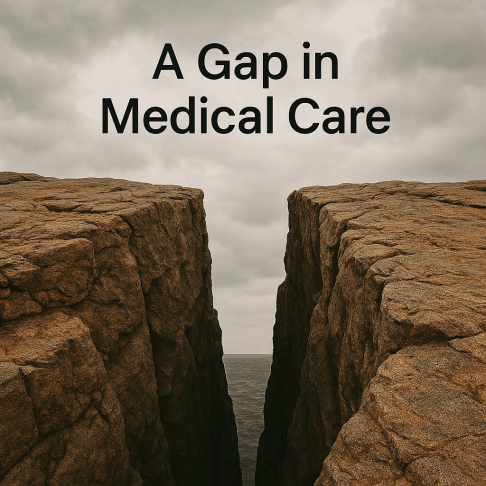 A ChatGPT 4-generated image at the request of the author- The absence of dementia rehabilitation is like standing at the edge of a vast canyon with no bridge in sight— terrifying to patients and carers alike.
The absence of a universally accepted rehabilitation model for dementia suggests an open door for innovation. If structured rehabilitation programs exist for conditions like Parkinson’s, could similar principles be adapted to dementia care?
Historically, dementia has been regarded as an irreversible, progressive condition, leading physicians to focus on palliative management rather than recovery-oriented rehabilitation. In contrast, Parkinson’s disease, despite also being neurodegenerative, has long been recognized as a movement disorder with modifiable symptoms, making rehabilitation a logical approach.
This divide can be traced back to entrenched medical attitudes. In the past, many physicians viewed dementia patients as having “no rehab potential”, effectively excluding them from therapy programs. A 2018 editorial in the Australian Age and Ageing Journal titled “Mrs. Smith has no rehab potential” challenged this assumption, highlighting how dementia patients are often denied rehabilitation opportunities, leaving family and caregivers with a deep sense of abandonment. The editorial argues that changing attitudes will require staff training and adequate resources to meet the needs of the growing dementia population.
These historical biases may explain why rehabilitation models for Parkinson’s disease have flourished while dementia rehabilitation remains largely unexplored. Dementia has been historically overlooked in disability discourse, with societies often treating individuals as either disabled or ill, rather than recognizing the potential for structured intervention. The mistaken idea that dementia patients can’t learn or improve greatly contributes to this dearth of rehab programs. In addition, the lack of autobiographical records due to dementia’s impact on memory and self-expression further contributes to marginalization, limiting research into rehabilitation strategies.
Yet, the overlap between Parkinson’s and dementia is undeniable—both are neurodegenerative conditions marked by progressive brain cell loss, cognitive impairment, emotional disturbances, and sleep dysfunction. Parkinson’s patients often experience memory issues and executive dysfunction; symptoms shared with dementia patients. Furthermore, Parkinson’s-related therapies, like LSVT BIG and LSVT LOUD, have proven effective in improving movement and speech, suggesting potential applications for dementia rehabilitation.
Institutions like Brooks Rehabilitation, PAM Health, and Johns Hopkins Medicine already offer structured rehabilitation programs for Parkinson’s patients, incorporating movement therapy, speech clarity techniques, and cognitive exercises. Could these methodologies inspire a new frontier in dementia rehabilitation? Given the evidence supporting neuroplasticity in Parkinson’s rehabilitation, similar strategies could help dementia patients sustain—and even recover a good deal of function.
At this stage, I cannot in good conscience let my story go unrecorded. My ability to write remains largely intact, providing me with a rare opportunity: to document my journey in real time, recording what may be an unprecedented case study in dementia rehabilitation. If targeted movement therapy, cognitive training, and speech programs can aid Parkinson’s patients (including those 40% with Parkinson’s-related dementia), then the possibility of bridging the gap to dementia recovery deserves due exploration. I believe the Parkinson’s rehabilitation model would provide a great starting point.
Medicine has made extraordinary strides. But here, in this one critical area, it stands eerily still. It’s high time to build the bridge. Or at least start laying the stones.
Respectfully Submitted,
Daniel Van Gent
About the Author
Daniel Van Gent is a systems thinker and writer whose lived experience with neurodivergence and health transitions informs his advocacy for dignity and adaptive care in dementia. A retired research radiochemist and medical physicist with a master of science in medical physics, he integrates scientific rigor with personal insight. His writing reframes dementia as a form of neurodiversity—an evolving transformation that can foster resilience. Daniel is a passionate e-triker and avid swimmer, navigating life with curiosity and intention.
🌟 About DAI
Dementia Alliance International (DAI) is a global advocacy and support organization led by and for people living with dementia. Our mission is to empower individuals with dementia to live with dignity, purpose, and support through peer-to-peer connections, education, and advocacy. Read more here.
🤝 Join Us
Are you living with dementia? Become a member today to access our peer support groups, webinars, and a global community of peers. Membership is free and open to people with a confirmed dementia diagnosis. Sign up here.
💙 Support Our Work
Your donations help us continue to provide free support services, raise awareness, and advocate for the rights of people living with dementia. Every contribution makes a difference. Donate here.
🔗 Connect With Us
Follow us on social media to stay updated!
Facebook | Twitter/X | Instagram | LinkedIn | YouTube
Or contact us directly at [email protected]