

❗Blogs approved for posting are opinions of the authors, and do not represent the opinions of DAI.
The Remarkable De Hogeweyk “Dementia Village”- A Blueprint For Living With End Stage Dementia.
De Hogeweyk, just outside Amsterdam in Weesp, is often described as the most impressive Dementia rehabilitation facility in the world—and for good reason.
Upon opening in 2009, De Hogeweyk reimagined a new path forward by creating a vibrant and safe community for people with late stage Dementia.
 “Proost!”
In 2009 the Hogeweyk in The Netherlands, the world’s first ‘dementia village’, opened in 2009. Now the village is renowned for its sustainable, inclusive and “person-centred” approach to high-quality and sustainable solutions towards breaking the stigma of dementia.
Co-Creators & Game Changers:
De Hogeweyk paved the way for care in The Netherlands and has become an inspiration for others in the world, looking for a more humanized approach in the aftermath of one’s Dementia diagnosis.
From Hogeweyk's perspective, years of experience and gained knowledge results in a clear vision of the future of dementia care going forward:”The Hogeweyk is one outcome, but applying that same vision, many other outcomes become possible.
We strongly believe in the deinstitutionalization of care and the need to emancipate people living with dementia and inclusion in society.”
The Blueprint
What Makes De Hogeweyk Unique?
It’s a real village, not an Institution: De Hogeweyk is designed to look and feel like a typical Dutch neighborhood, with streets, gardens, a grocery store, a restaurant, theater, barber shop, and open green spaces. Residents can stroll and shop for groceries, stop for a coffee, and participate in daily life, all within a secure environment - well now, talk them tulips?
Person-Centered, Inclusive Living: The Residents of De Hogeweyk live in small households (6–7 people) with familiar lifestyles and cultural backgrounds. Each home has private bedrooms, a living room, kitchen and outdoor spaces that support both privacy and community236.
Invisible, High-Quality Care: Professional care is provided around the clock, where the facilities’ staff blend in as neighbours and friends in regular clothes while supporting residents discreetly. The goal is to minimize the feeling of being unencumbered in a care facility based on normalcy and autonomy. Boyah!
Community Integration: De Hogeweyk actively welcomes visitors from the surrounding area, hosting events and opening amenities to the public. This reduces stigma and fosters genuine social interaction between residents and the wider community. “Come on people now, shine on your brothers (and sisters)”
Freedom and Safety: The entire village is secure, but residents are free to move about as they wish. This balance between safety and independence is a core part of the design.
Real, self-agency
Imagine That.
 Source: AI Generated Image
Indeed, De Hogeweyk is a rare breed of its own, in that, it breaks the mold of traditional dementia care: Instead of focusing on “patient containment” or purely medical management treatment (AKA, basically a whole lot of elderly people trapped in beds and waiting to die), The De Hogeweyk empowers residents to live meaningful and self-directed lives with intention.
Truly Empathetic Patient Care:
The common challenges are designed to reduce confusion, agitation, and isolation—all common challenges in Dementia—by supporting familiar routines and social engagement.245 Further, its success has inspired similar projects worldwide and has set a new standard for what dementia rehabilitation can achieve with dignity, autonomy, and quality of life, even in the late stages of one’s Dementia diagnosis.249
“If you step inside the Hogeweyk, it’s just another neighbourhood. You probably won’t even recognise the residents from the volunteer’s, or who is a family member.”5
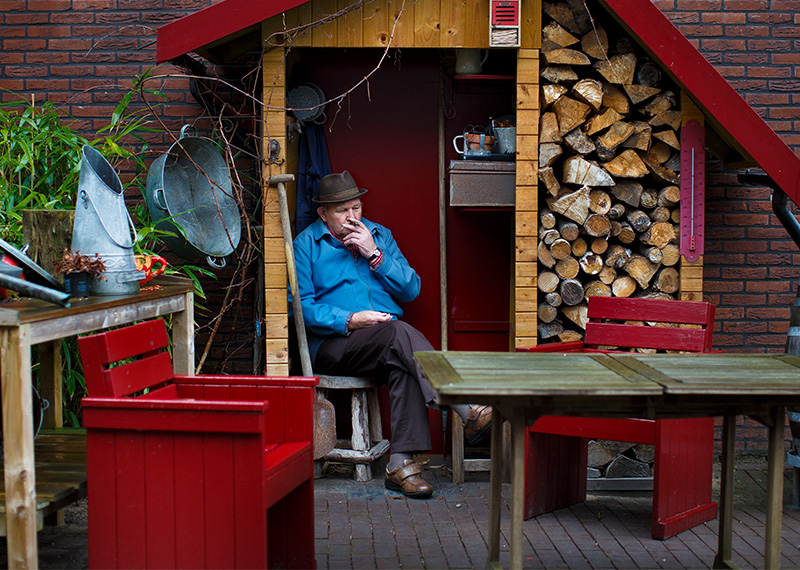 Source: Photos of De Hogeweyk “Dementia Village”
Canada's Version Of The De Hogewey Dementia Villages Recreates Normal Life.
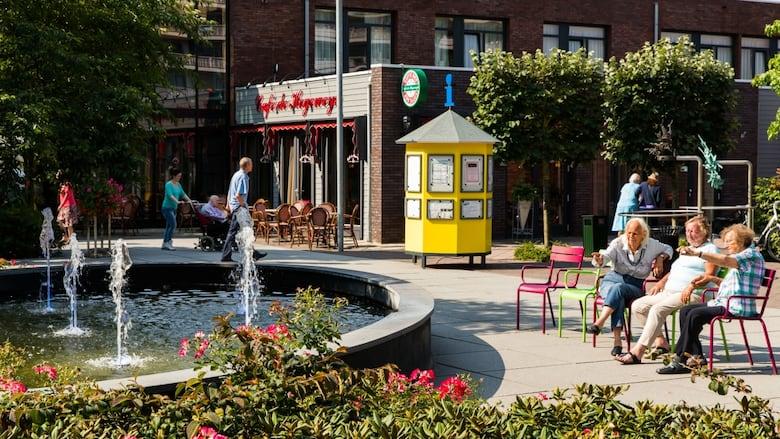 The 152 residents of Hogewey village aren't bound to stay indoors. The front doors of the neighbourhood's 23 houses face a park, squares and courtyards that residents can stroll through. (Courtesy of Hogewey)
Social Sharing
In a Dutch town about 20 kilometres outside of Amsterdam, a small community lives in what at first glance seems like a real-life version of The Truman Show.
Hogewey has a grocery store, a theatre and a barber shop. The only twist is that many of its 152 residents live unaware that their orderly community is actually a nursing home for people with severe dementia.
"We protect our residents from the unsafe world. They do not understand the world outside this because the outside world doesn't understand them," says Yvonne van Amerongen, an employee at Hogewey who also helped develop the concept.
Hogewey was officially opened in 2007, but the idea has now caught the attention of health-care professionals in Ontario and Alberta.
Rhonda Desroches, who helped create a smaller-scale Hogewey in Penetanguishene, Ont., says relatives of the residents are pleased with how happy their family members seem to be in the new facility.
Dementia is a growing problem. According to the Alzheimer Society Canada, one out of 20 Canadians over 65 has Alzheimer's Disease, and that figure jumps to one in four for Canadians over 85. In 2012, the World Health Organization declared dementia a public health priority.
Many dementia patients move into nursing homes, where they are monitored in a safe setting. But some medical professionals want to shift patients away from unfamiliar, clinical settings and into spaces that resemble more typical surroundings.
Places like Hogewey.
Restaurant, theatre and other amenities
Hogewey creates a familiar, "normal" environment that dementia patients understand, says van Amerongen.
The citizens of Hogewey share a house with about six others, and are classified according to one of seven lifestyles.
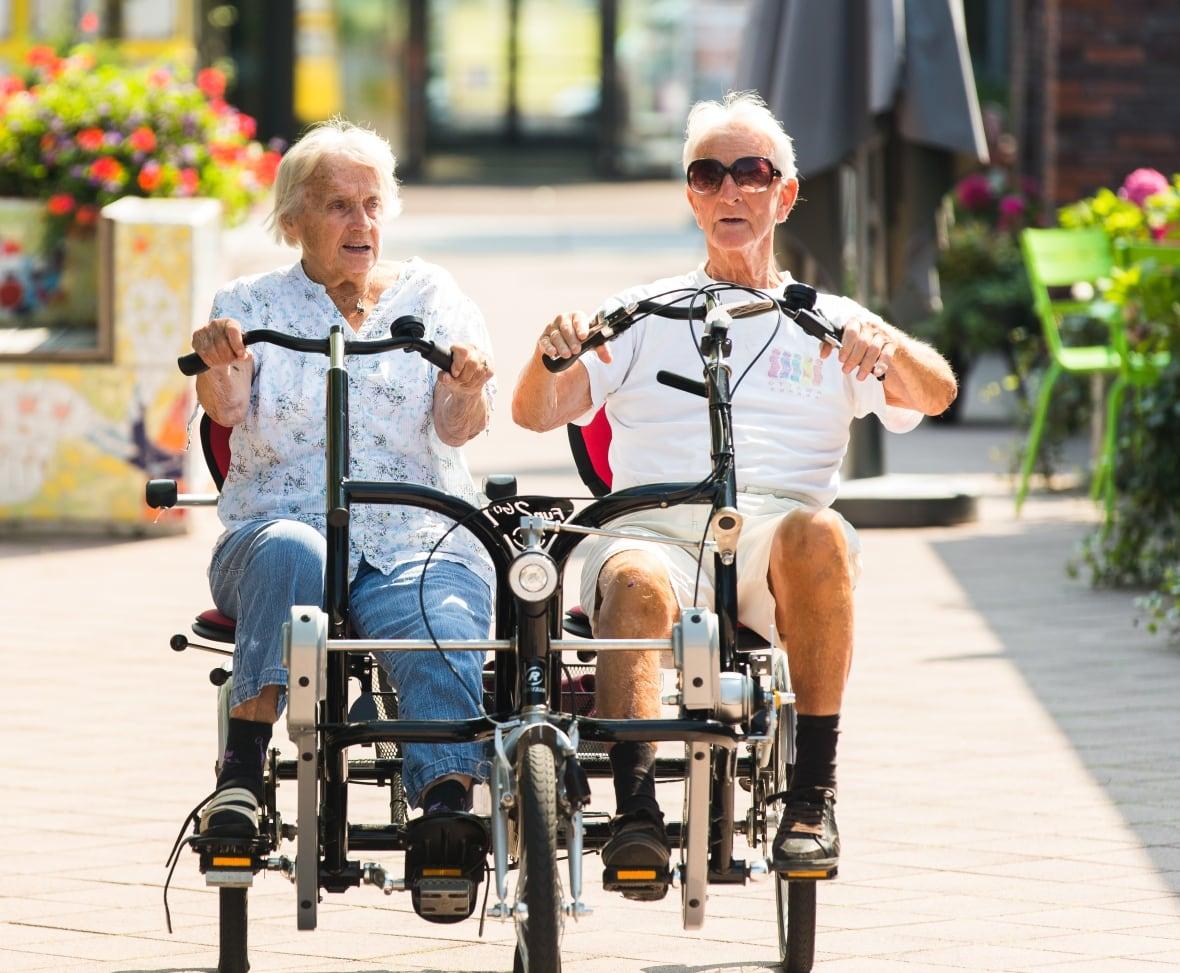 "We go out for bicycle trips because this is Holland,' says van Amerongen of the neighbourhood's three special bikes that allow two people to sit side-by-side." (Courtesy of Hogewey)
For example, former tradespeople often live together in homey accommodations and eat a lot of Dutch comfort food. Those used to an upper-class lifestyle may join the Gooi group, named after a posh Netherlands region, and are more likely to feast on French cuisine in a stylishly decorated abode.
Each household has at least one health-care worker present who helps with housework and other tasks.
Residents are free to stroll all through town.
"You will see [residents] sitting in a restaurant with a glass of wine or buying a box of chocolates from the supermarket," says van Amerongen of those who still understand the concept of money. A worker and a resident from each house walk to the market daily to buy groceries.
Employees organize day trips to nearby shopping centres or towns. Special bikes allow two people to sit side by side so residents and health-care workers, volunteers or family members can cycle in pairs.
Nearby townspeople frequent Hogewey's amenities, and often go to concerts or the annual Christmas fair. On Sint Maarten, a Dutch holiday similar to Halloween, children knock on residents' doors to sing songs in exchange for candy.
Like all Dutch nursing homes, Hogewey is partially funded through taxes. Residents pay a portion of the cost based on their income.
'Wonderful innovation' inspires copycat homes
Van Amerongen says she regularly consults with organizations outside the Netherlands that want to create similar facilities. Plans to transform four existing nursing homes and build two new ones in Oslo, for example, have progressed "quite far," she says.
One of her colleagues frequently travels to Canada where there's increased interest in developing the concept. Researchers from the University of Alberta recently visited Hogewey to study it.
Last August, Georgian Bay Retirement home in Penetanguishene, Ont., opened a section designed to recreate the look and feel of the 1950s and '60s.
Theme rooms include a vintage kitchen, a garage with a 1947 Dodge and a nursery with dolls designed to feel like actual babies, says Rhonda Desroches, who helped create the space. The idea is to try and transport patients to a time they may recall that is associated with positive feelings.
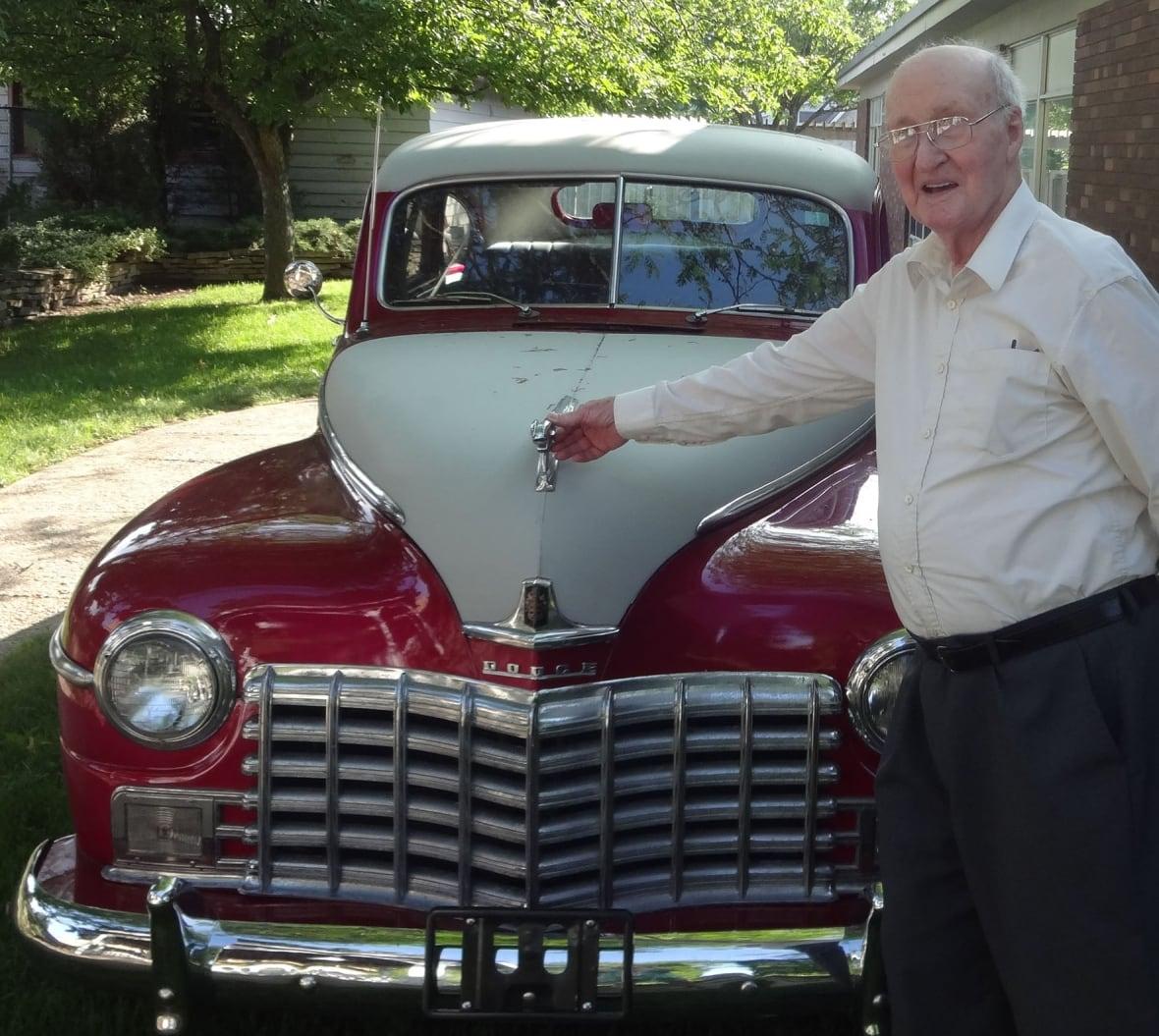 Georgian Bay Retirement home opened a memory care centre unit based on the Hogeway model last April. The facility is built to remind residents of the '50s and '60s. (CNW Group/Georgian Bay Retirement Home)
All the doors in the theme rooms look like bookshelves, so residents won't recognize them and stray.
In Florida, a company called Miami Jewish Health Systems wants to create a program that reflects Hogewey's philosophy "to really make living as normal as possible within the scope of the disease," says Marc E. Agronin, the company's vice-president of behavioural health and clinical research.
Miami Jewish Health Systems is planning a transformation of its 28-acre campus to give dementia patients more freedom by creating a safe space where they're not confined to their rooms.
Total honesty can cause 'significant problems'
While certain health-care professionals see Hogewey as the future of dementia care, others criticize it for being dishonest.
Some aspects of Hogewey seem "fantastic," says Julian Hughes, the deputy chair of the Nuffield Council on Bioethics in London, England, which studies ethical issues in biology and medicine and advises policy makers.
It's worrisome when a village or aspects of it are deliberately deceitful, says Hughes, who was part of a working group for Nuffield's 2009 report on ethical issues in dementia, including truth-telling.
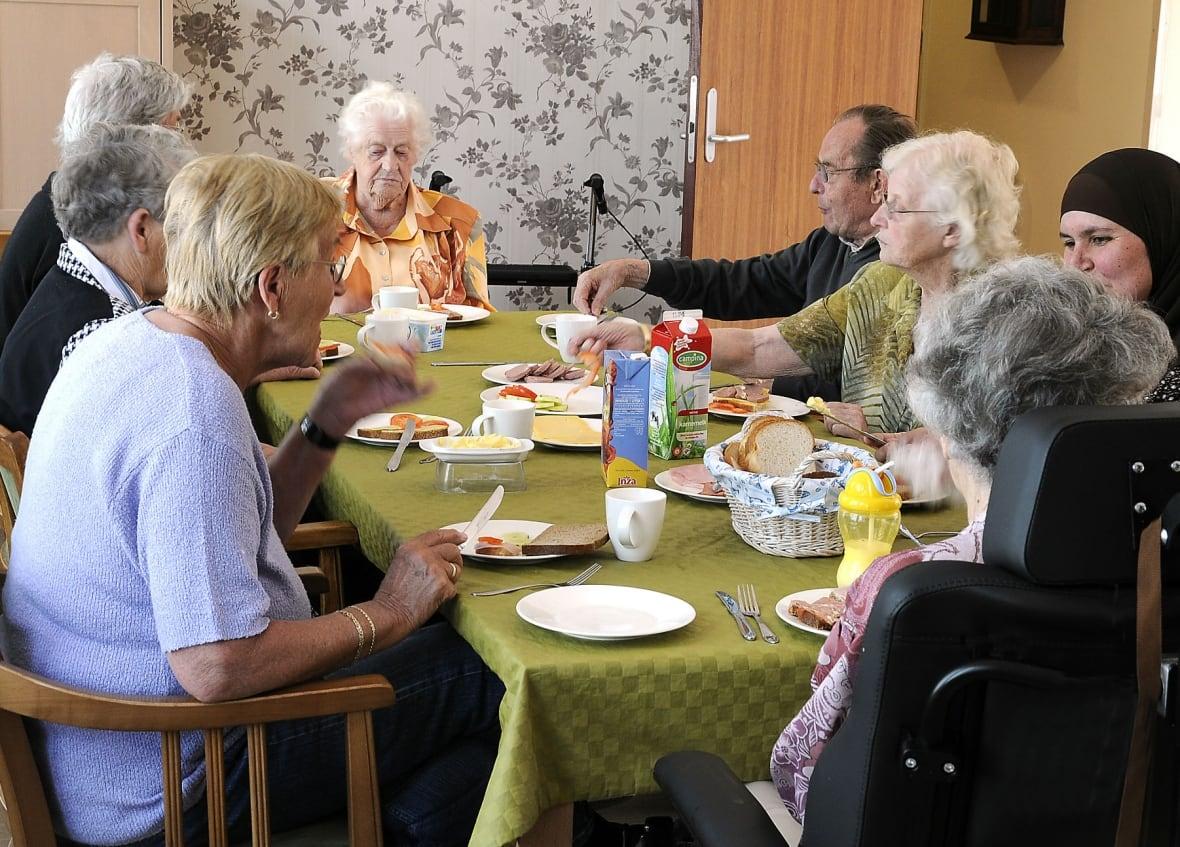 Incoming residents answer a series of questions about their preferences before moving in to help the facility determine which lifestyle group the person ought to live in. (Courtesy of Hogewey)
Some nursing homes have built fake bus stops outside their facilities, Hughes says. When patients want to leave the facility and go home, health-care workers take them to the bus stop. After a while, caregivers can distract the person, presumably taking advantage of the fact that they have forgotten where they were going, and bring them back inside.
There are those that believe deceiving dementia patients breaches their trust. As the council's report states, some say it "serves to undermine the remaining grip the person with dementia may have on the everyday world."
Patients who realize something is amiss could become upset and slightly paranoid, Hughes says.
Van Amerongen insists that this kind of criticism comes from people who misunderstand how Hogewey operates. The people who work at Hogewey aren't merely actors trying to create the illusion of a normal neighbourhood, she says.
There are nurses on staff, but the amenities are operated by real cooks, waiters and other employees who aren't health-care professionals. They're just trained to deal with dementia patients.
"There's no trick here," says van Amerongen.
She says that while some Hogewey residents recognize the caregivers as nurses, others simply think of them as "a nice friend."
Some deception is morally OK
Hughes says it's morally acceptable not to ruthlessly tell dementia patients the truth about certain situations.
In its 2009 report, the Nuffield Council determined it's important to consider a person's best interests, like whether the information would needlessly distress them. The council said sometimes it may be best to evade or give partial answers.
When you tell someone suffering from dementia that a loved one has died, they may not remember, says Agronin from Miami Jewish Health Systems. It often makes little sense to repeatedly deliver the news, traumatizing them each time.
Agronin says that for him, it's about making people feel comfortable and oriented. That can be achieved by some of the things Hogewey does, like furnishing a patient's room and common spaces to be reminiscent of their previous home.
"There's a difference between a Potemkin village where everything is just a facade [and] a place like Hogewey."
Source: CBC's Journalistic Standards and Practices·About CBC News
About the Author
Dave’s journey into young onset dementia began in the fall of 2023, at age 51, when friends and family started to notice a change in his cognition and memory. He was the last to know, and he suspects that probably rings true for those of you reading this and grappling with this disease out of the gates.
Little-by-little, though, Dave has come to largely accept his dance with dementia, without looking too far down the road. Moreover, he has a newfound perspective that sheds light on what is most important in his life. Dave’s career focused on content and copywriting for many organizations including managing the digital media portion of the London 2012 Olympics and working with companies including MLSE entertainment, Rogers Media and Canadian Running Magazine.
He is an avid photographer and loves to run - a lot - which helps him keep his brain healthy. Dave lives in Toronto with his wife, his dog, and two children aged 18 and 20 who are currently attending university.
❗Blogs approved for posting are opinions of the authors, and do not represent the opinions of DAI.
🌟 About DAI
Dementia Alliance International (DAI) is a global advocacy and support organization led by and for people living with dementia. Our mission is to empower individuals with dementia to live with dignity, purpose, and support through peer-to-peer connections, education, and advocacy. Read more here.
🤝 Join Us
Are you living with dementia? Become a member today to access our peer support groups, webinars, and a global community of peers. Membership is free and open to people with a confirmed dementia diagnosis. Sign up here.
💙 Support Our Work
Your donations help us continue to provide free support services, raise awareness, and advocate for the rights of people living with dementia. Every contribution makes a difference. Donate here.
🔗 Connect With Us
Follow us on social media to stay updated!
Facebook | Twitter/X | Instagram | LinkedIn | YouTube
Or contact us directly at [email protected]